

Picture this: you're standing in the pet aisle, holding two tubs of gut supplements, and both labels promise a happier tummy for your dog. One says "probiotic." The other says "prebiotic." They sound almost identical, and yet the internet keeps insisting they're not the same thing at all.
You're not imagining the confusion. Even some vets get a little tongue-tied explaining it in a ten-minute appointment.
Here's the good news: once you understand what each one actually does inside your dog's gut, the choice gets a lot easier. And more often than not, the real answer isn't "one or the other." It's both, working as a team.
This guide breaks down prebiotics for dogs, probiotics for dogs, and how to tell which your own dog needs, so you can stop guessing in the supplement aisle.
Why dog digestive health depends on more than just food
Your dog's gut isn't just a tube that moves food from one end to the other. It's home to trillions of bacteria, fungi, and other microbes collectively known as the gut microbiota.
That community does a lot of quiet work. It helps digest food, produces short-chain fatty acids that feed the cells lining the colon, and trains a big chunk of your dog's immune system. (1)
When that microbial community is balanced, you tend to see it in ordinary, boring ways: firm stool, a steady appetite, no random gassy evenings on the couch. When it's out of balance, a condition researchers call dysbiosis, the signs show up too: loose stool, excess gas, itchy skin, or a gut that seems to fall apart every time your dog eats something new.
The two tools vets reach for
Supporting that microbial community usually comes down to two strategies. You either add more good bacteria directly, or you feed the good bacteria that are already living in your dog's gut so they can do more of the work themselves.
That's the entire difference between a probiotic and a prebiotic in one sentence. The rest of this article is just filling in the details.
-
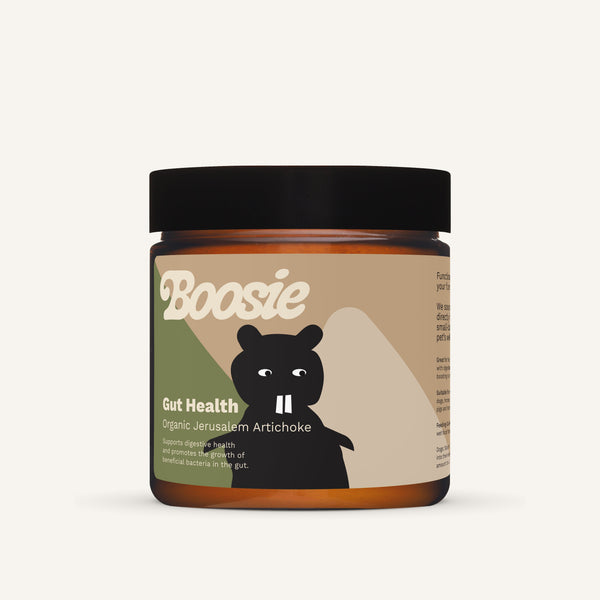
Organic Jerusalem Artichoke Powder
-

Organic Turkey Tail Mushroom Powder

What are probiotics for dogs?
Probiotics are live microorganisms that, in the right amounts, provide a health benefit to the host, which in this case is your dog. (1)
They're the bacteria themselves. Strains like Lactobacillus, Bifidobacterium, and Enterococcus faecium are the ones most often studied and used in dog supplements and prescription diets.
A 2019 systematic review in the Journal of Veterinary Internal Medicine looked across dozens of clinical trials and found that certain probiotic strains genuinely help shorten the duration of acute diarrhoea in dogs and may lower the odds of antibiotic-associated diarrhoea. (1) That's a meaningful, practical result, not just a marketing line.
Probiotics work by temporarily joining the existing bacterial population, competing with less helpful bacteria for space and nutrients, and nudging the whole ecosystem toward better balance. The word "temporarily" matters here. Most probiotic strains don't set up permanent residence. They need to be topped up regularly to keep contributing.
Why probiotic strains aren't interchangeable
Not every probiotic does the same job. Enterococcus faecium, for example, has been studied specifically in dogs with food-responsive chronic enteropathy, where it measurably improved clinical activity scores compared to a placebo. (1)
That kind of strain-specific research is exactly why "probiotic" on a label doesn't tell you much on its own. The species and strain matter, and so does keeping the bacteria alive long enough to reach your dog's gut.
What are prebiotics for dogs?
Prebiotics work from a completely different angle. Instead of adding bacteria, they feed the ones your dog already has.
Technically, a prebiotic is a substrate that's selectively used by host microorganisms to confer a health benefit. (2) In plainer terms: it's a type of fibre your dog can't digest on its own, but the good bacteria in the colon absolutely can.
Inulin and fructooligosaccharides, often shortened to FOS, are the most researched prebiotic fibres for dogs. You'll find them naturally in foods like Jerusalem artichoke, chicory root, and asparagus.
A 2023 review in the journal Fermentation examined 36 studies on prebiotic supplementation in healthy dogs and found that fibres like inulin and FOS consistently increased populations of beneficial bacteria such as Lactobacilli and Bifidobacteria, while reducing potentially harmful bacteria like Clostridium perfringens and E. coli. (2) The review also noted improved short-chain fatty acid production, particularly butyrate, which is the preferred fuel source for the cells lining your dog's colon. (2)
Jerusalem artichoke as a natural inulin source
Jerusalem artichoke, sometimes called sunchoke, is one of the richest natural sources of inulin around. A pyrosequencing study on cats and dogs supplemented with FOS and inulin found measurable shifts in the faecal microbial community during supplementation, supporting the idea that these fibres actually change what's living in the gut, not just what passes through it. (3)
Boosie's Organic Jerusalem Artichoke Powder is built around exactly that fibre, in a simple single-ingredient form. If you're curious whether it's actually safe to feed daily, we've covered that in detail in Is inulin safe for dogs?
Prebiotic vs probiotic for dogs: how they're actually different
Here's the short version, side by side.
Probiotics are live bacteria you're adding to the gut. Prebiotics are fibre that feeds the bacteria already there. Probiotics act more like new hires showing up to help. Prebiotics act more like better rations for the staff you've already got.
Neither one replaces the other, which is exactly why the "vs" in the title is a little bit of a trick question. They're not competitors. They're two different levers for the same goal, and research increasingly points toward using them together.
Synbiotics: when prebiotic and probiotic work as a team
When you combine a prebiotic and a probiotic on purpose, matching the fibre to the bacteria it feeds best, that combination has a name: a synbiotic.
A review in the Italian Journal of Animal Science on prebiotics and synbiotics in dogs describes how prebiotic fibres can support the survival and activity of probiotic strains as they move through the digestive tract, making the combination more effective than either ingredient used alone in some contexts. (4)
That's the logic behind pairing something like a probiotic strain with a fermentable fibre such as turkey tail mushroom or Jerusalem artichoke. Turkey tail contains beta-glucans, a type of fiber that's partly fermented by gut bacteria and has also been studied for its immune-supporting effects in dogs, including a clinical study on dogs with hemangiosarcoma where a turkey tail-derived compound was linked to longer survival times.(5) Boosie's Organic Turkey Tail Mushroom Powder leans on that same beta-glucan content for gentle digestive and immune support.
Signs your dog might benefit from either one
Not every dog needs a gut supplement. But certain patterns are worth paying attention to.
Soft stool and occasional digestive upset
If your dog's stool is regularly a little too soft, or you notice the occasional gassy evening with no obvious cause, that's often the first visible sign of a gut community that could use support. This is a common enough starting point that we wrote a full breakdown of what those symptoms tend to look like in Dog poor gut health in symptoms.
After a course of antibiotics
Antibiotics don't just knock out the bacteria causing an infection. They also disrupt the beneficial bacteria living in the gut, sometimes for weeks afterwards.
A 2025 study in Research in Veterinary Science found that probiotic supplementation helped counteract antibiotic-induced dysbiosis in healthy dogs, supporting a faster return to a more balanced gut community. (6) This is one of the clearest, most practical times to reach for a probiotic specifically, since the goal is restocking bacteria that were just wiped out.
Itchy skin and allergies tied to the gut-immune axis
This one surprises people. Skin and gut don't seem related at first glance, but a lot of your dog's immune system actually develops around the gut.
Research comparing the gut microbiome of atopic dogs to healthy dogs has found real differences in bacterial diversity and composition between the two groups. (7) Separately, a 2025 study published in BMC Microbiology found that probiotic supplementation helped ease atopic dermatitis symptoms in dogs, partly by correcting an imbalanced gut microbiota. (8)
None of this means a probiotic replaces your vet's treatment plan for allergies. It does mean gut support is a reasonable, evidence-backed piece of the bigger picture, especially for dogs with chronic itchy skin. Our article on How to improve dog gut health naturally goes deeper into that connection.
So which does your dog actually need
If your dog is generally healthy with the occasional soft stool, a prebiotic fibre is usually the gentler place to start. It feeds the bacteria your dog already has without introducing anything new.
If your dog just finished antibiotics, is recovering from acute diarrhoea, or has a diagnosed condition like food-responsive enteropathy, a probiotic with a researched strain is the more direct tool, since you're actively replacing bacteria that were lost.
And if your dog deals with ongoing digestive sensitivity, itchy skin, or both, using a prebiotic and probiotic together, a synbiotic approach, tends to cover more ground than either one alone. That's the thinking behind Boosie's Healthy Gut Set, which pairs Jerusalem artichoke powder with turkey tail mushroom powder rather than asking you to choose one.
If your dog has a more complicated history, like a leaky gut diagnosis or an ongoing GI condition, it's worth reading What to feed a dog with leaky gut and looping in your vet before adding anything new.
Safety, dosing, and introducing gut supplements gradually
Both prebiotics and probiotics are considered safe for most healthy dogs, but "more is better" isn't the right instinct here.
Too much prebiotic fibre, introduced too quickly, can overwhelm the fermentation process in the colon and cause gas, bloating, or loose stool, which is the opposite of what you're going for. The fix is simple: start with a small fraction of the recommended amount and build up over one to two weeks.
The same slow approach applies to probiotics. Adding a new strain of bacteria all at once can temporarily unsettle a gut that isn't used to it, so easing in gives your dog's system time to adjust.
Dogs with a diagnosed illness, a compromised immune system, or any prescription medication should only start a new supplement with a vet's input, since interactions and appropriate strains can vary quite a bit case by case.
Frequently asked questions
Can I give my dog a prebiotic and probiotic at the same time?
Yes. In fact, using them together, sometimes called a synbiotic approach, is where a lot of current research is pointing, since the fibre can help support the bacteria you're adding. (4)
How long does it take to see results?
Most owners notice changes in stool consistency and gas within one to three weeks of consistent use, though every dog's gut community responds on its own timeline.
Are prebiotics or probiotics better for a dog with diarrhoea from antibiotics?
A probiotic is usually the more direct choice here, since antibiotics reduce the population of good bacteria that a probiotic can help replace. (6) A gentle prebiotic fibre alongside it can support those bacteria once they're established.
Can puppies have prebiotics or probiotics?
Many are safe for puppies, but always check the specific product and dose with your vet first, since a puppy's gut microbiome is still developing.
Will a gut supplement fix my dog's itchy skin?
It might help as part of a bigger plan, since gut and skin health are linked through the immune system, but it isn't a standalone treatment for allergies. (7)(8) Persistent itching is always worth a vet visit.
The bottom line
Prebiotics and probiotics aren't rivals fighting for space in your dog's bowl. They're two different jobs: one feeds the good bacteria already there, the other adds reinforcements.
Most dogs don't need a complicated protocol. They need a little bit of the right fibre, sometimes a probiotic strain when the gut has taken a hit, and an owner willing to introduce things slowly and watch how their own dog responds.
If you're still not sure where to start, our guide to the best prebiotic for dogs and our broader roundup of the best gut supplement for dogs are good next stops. And if in doubt, your vet is always the best tiebreaker for your dog's specific situation.


